




Turbomachinary test bench
The ‘Rotating Machines’ platform brings together the ENSAM Lille turbomachinery testing facilities and the ONERA Lille rotor and propeller test benches.
The combination of the turbomachinery testing facilities at ENSAM and the rotor and propeller test benches at ONERA Lille constitutes a highly original set of facilities for testing incompressible or slightly compressible rotating flows, in internal or external aerodynamics, with certain devices that are unique in France or in Europe. It should also be noted that the available resources range from laboratory models for focusing analysis on specific physical phenomena to industrial-scale test benches. These include:
- A test bench dedicated to the study of space inductors operating in cavitation mode (the only one of its kind in Europe)
- A test bench enabling rapid pump start-ups, with only one equivalent in the world
- An axial compressor test bench, formerly owned by Paris Sorbonne University and now installed in Lille under an agreement between that institution and ENSAM. This test bench is particularly suited to studying the operation of compressors in unstable conditions
- A test bench dedicated to rotor/rotor interaction, consisting of a model helicopter with a fully articulated rotor 1.5 m in diameter and a motor+propeller assembly whose position can be adjusted along three axes
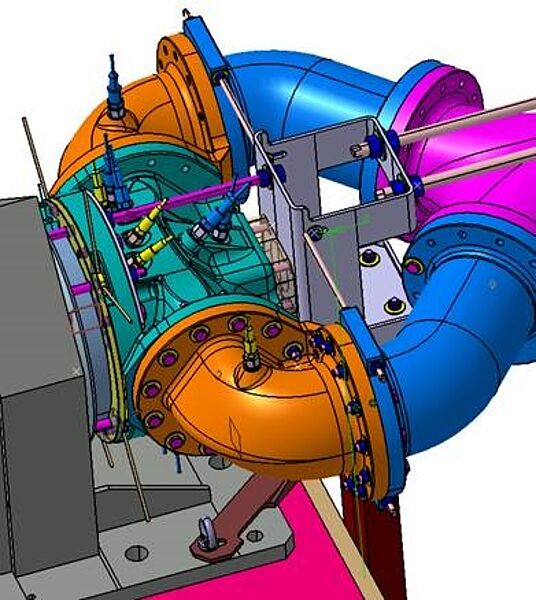
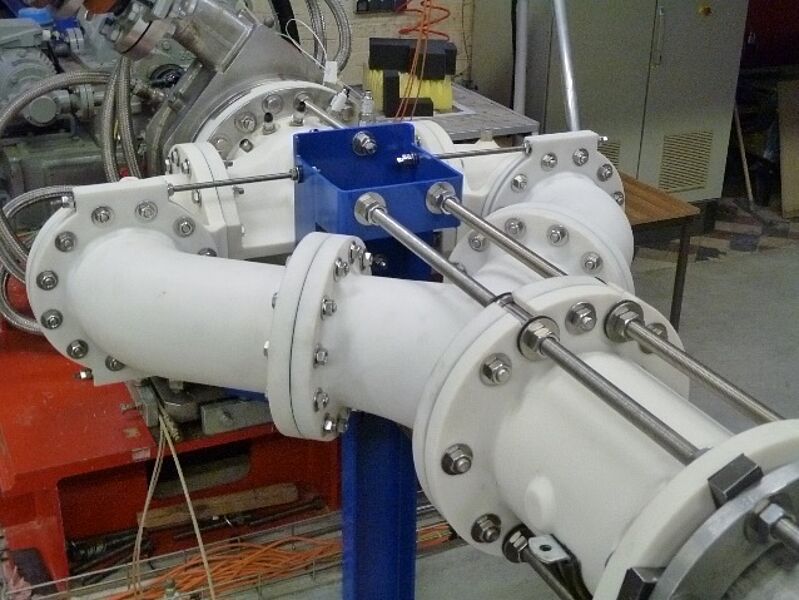
The SESAME loop is a hydraulic loop dedicated to studying cavitation and instability in the first stages of space engine pumps. Significant investments have been made as part of a contractual partnership between the laboratory and players in the national space industry (CNES and ArianeGroup).
Technical characteristics:
Power: 200 kW
Speed: 6000 rpm
Fluid: water
The CME2 bench is an axial compressor bench that replicates a compression stage in an aircraft engine. Its robustness makes it particularly well suited to studying unstable phenomena (rotational separation, pumping) that occur in these machines when operating at partial flow. The bench has recently been equipped with fluidic actuators, which have been used in particular in an ANR project and a European project. A distortion grid device has also been adapted to simulate azimuthal inhomogeneities in total pressure at the machine inlet.
Technical characteristics:
Power: 200 kW
Speed: 6300 rpm
Fluid: air
This bench is used to study rotor/stator interactions and instabilities in turbomachinery.
Technical specifications:
Power: 7.5 kW
Speed: 2500 rpm
Fluid: air
Technical specifications:
Power: 15 kW
Speed: 2,900 rpm
Fluid: water
Start-up: 0 to 3,000 rpm in 0.4 seconds
This test bench is used to study the interaction of wakes with and without wind. The bench can be positioned in ONERA's L2 wind tunnel.
Technical characteristics:
Main/secondary rotor diameter: 1.5 m / 0.3 m
Measurements: 6 components on both rotors, RPM, PIV
The Rotor bench is used to study the interaction of rotor wake in inhomogeneous flows (interactions with the ground, buildings, turbulent ship wake, etc.).
Technical characteristics:
Main rotor diameter: 0.7 m
Measurements: 6 components, RPM, PIV, pressure on obstacles