




Turbulence
Presentation
Theme leader : Christos Vassilicos
This topic aims to study and model the physics of turbulence and turbulent flows using experimental, numerical and theoretical methods. The research covers a wide variety of single-phase and two-phase turbulent flows, including turbulent boundary layers (zero/favourable/unfavourable pressure gradient), various turbulent wakes, various cases of turbulence generated by grids, turbulent jets, turbulence inside a rotary blade mixer, atmospheric turbulence and turbulent flows in urban environments. The experimental side of this research topic relies on This topic aims to study and model the physics of turbulence and turbulent flows using experimental, numerical and theoretical methods. The research covers a wide variety of single-phase and two-phase turbulent flows, including turbulent boundary layers (zero/favourable/unfavourable pressure gradient), various turbulent wakes, various cases of turbulence generated by grids, turbulent jets, turbulence inside a rotary blade mixer, atmospheric turbulence and turbulent flows in urban environments. The experimental side of this research topic relies on PLEX
Objectives
The problem of turbulence is, ultimately, to massively and reliably reduce the number of degrees of freedom and thereby enable fast and accurate turbulent flow predictions. This problem is vast because of the vast range of turbulent flows present widely in nature and engineering. Part of the problem is to determine whether faithful reductions of the number of degrees of freedom are at all possible and up to what level of reduction for which turbulent flow quantities and for what class of turbulent flows. Is this possible perhaps even universally for at least some turbulent flow aspects? These goals require transformative advances and breakthroughs in our understanding of the fundamental physics of turbulence and turbulent flows leading, in particular, to the definition and characterisation of distinct universality classes of turbulence physics and to novel reduced order modeling approaches. These essential steping stones require the study of a wide range of of turbulent flows in parallel theoretically, experimentally and computationally. This is indeed the approach of the turbulence research at the LMFL which also includes a permanent eye on applications, turbulence modeling and turbulent flow design and control.
The theme is sub-divided into three themes:
Simulations of rare events in a bistable turbulent jet
This topic focuses on the numerical study of a bistable turbulent flow generated in the wake of two parallel bars. When the gap between the bars is sufficiently small, the resulting jet can spontaneously oscillate between two stable states, oriented to the left or the right of the central axis. This phenomenon of multistability, common in atmospheric or oceanic flows, is associated with rare transitions whose understanding is essential, particularly in the context of climate change. The objective is to identify the physical mechanisms responsible for bistability and regime changes through large-scale three-dimensional simulations (LES) and the use of rare event simulation methods. The project includes the implementation and validation of simulations with the XCOMPACT3D code, a parametric study, the analysis of boundary forcings, the development of new observables and the use of statistical methods to efficiently sample transitions.
ERC AdG NoStaHo (2022-2027)
Non-homogeneous and/or non-stationary turbulence
This project focuses on energy transfers and cascades in turbulence, in particular the intermittent aspects in space and time, the aspects of non-homogeneity and non-stationarity, and the resulting dissipation
properties in various non-homogeneous turbulent flows.
The ways that energy and scalar transfers in scale-space interact with such transfers in physical space is also an important focus of the project. These are fundamental turbulence physics which have a pivotal impact on the evolution of turbulent flows, including on the most salient features of these flows such entrainment and turbulent growth of wakes/jets/boundary layers and on turbulence prediction approaches.
This project combines theory, numerical simulations and laboratory experiments and consists of various sub-projects such as the following.
- Inter-scale and inter-space energy transfers at the Turbulent/Non-Turbulent Interface (TNTI) of turbulent wakes and jets.
- Entrainment and speed of the TNTI relative to the fluid in various types of turbulent boundary layers (FPG/ZPG/APG) and various types of turbulent wakes.
- Inter-scale and inter-space energy tranfers in wall turbulence including turbulent channel flow with/without convection and turbulent boundary layers
- The impact on turbulent fluctuations and skin friction of attached-eddy structures in turbulent boundary layers and turbulent channel flows.
- Helicity and inter-scale and inter-space energy and scalar concentration transfers in closed container mixers stirred by regular/fractal blades, with/without baffles.
- Helicity and coherent structures and their relation to non-equilibrium turbulence dissipation in turbulent wakes.
ANR ENRICO (2026-2030)
Interscale energy transfers by direct high frequency forcing
(Collaboration LMFL - PPRIME)
In many industrial processes, efficient mixing with a high level of turbulence is required within a confined, small-scale volume. Given that dissipation increases with increasing turbulence and decreasing size, this makes dissipation, and thereby power input and energetic efficiency of mixing, a central concern. This project is aimed at introducing groundbreaking technology to strategically modify targeted small, e.g., dissipative or inertial, turbulent scales. By adjusting energy transfers through both scales (cascade) and space (scale-by-scale turbulent diffusion), this approach seeks to enhance fluid mixing efficiency by simultaneously influencing turbulence intensity and dissipation levels. The research program will focus on the controlled and reproducible environment of grid turbulence in its near-isotropic form to determine the extent to which energy transfer mechanisms across scales and space can be artificially influenced. Understanding and controlling these interactions could unlock new possibilities for optimizing mixing efficiency in various industrial applications where turbulence plays a critical role in performance and energy consumption.
Influence of rain on the characteristics of the turbulent boundary layer
The objective is to improve the understanding and prediction of the aerodynamic characteristics of an object in the presence of rain. Experimental studies will be carried out in the new Rainaero (PLEX) wind tunnel by including water droplets in the flow, which are likely to modify characteristics such as those of the boundary layer. Theoretical and numerical studies are underway.
ANR TWIN (2025-2029)
Turbulents wakes and inertial particles coupling
Interaction of particle-laden turbulence with Ahmed bodies. Effects of rainfall in the drag and bi-stability of road vehicles (Collaboration PPrime - LEGI - LMFL)
The performance of a large number of industrial applications depends on their aerodynamic properties. This is the case for transport in general, but also for renewable-energy production systems. Climatic hazards are disruptive factors that can significantly alter the aerodynamics of these systems. These phenomena are exacerbated by climate change. However, these hazards are generally neglected in the design and/or operating phases due to the lack of reliable and affordable models. In this project, LMFL contributes by studying the properties of the wake and aerodynamic coefficients of Ahmed bodies (which mimic several aspects of trucks) in a wind tunnel under different rainfall conditions.
ANR MUSICO (2025-2029)
Study of the hydrodynamics of bubble columns at large void fractions
(Collaboration IMFT - CEA-STMF -LMFL)
Bubbly flows are present in many natural phenomena and industrial processes. This project focuses on the structure of turbulence induced by a swarm of rising bubbles. More specifically, it concerns the so-called fully heterogeneous regimes, which are observed in bubble-column flows of large dimensions and large void fractions. This regime is relevant for several industrial situations, as it is where optimal interfacial transfer and mixing occur. LMFL is currently building a large bubble column (60 cm in diameter and up to 5 m high), where experiments will be performed in both the homogeneous and heterogeneous regimes. These experiments will complement further experiments and numerical simulations conducted at IMFT and CEA-STMF.
IUF Junior M. Obligado (2025-2029)
Large and small scale unsteadiness in turbulent flows
Particle-laden turbulent flows are ubiquitous in nature and industry. While current models for both phases describe their time-averaged properties, many relevant phenomena are linked to flow unsteadiness. Examples include extreme events, particle clustering, and mixing, among others. This project will exploit recent experimental and modelling developments to enable the simultaneous characterization of a particle-laden turbulent field in both space and time. This project proposes a series of experiments in different facilities, aiming to model the properties of turbulent flow - also in cases where they carry particles - for different scenarios.
Transport of inertial particles at interfaces and in inhomogeneous flows
The experimental side of this activity consists of a joint effort with the Department of Engineering at the University of Washington concerning the study of the behaviour of inertial particles (water droplets) generated in a series of wind tunnels located at both institutions. In particular, we investigate the behaviour of particles as they cross an interface between a turbulent and a non-turbulent region of the flow, or between two different turbulent states. Indeed, in several industrial and natural situations, such as clouds and jets, such interfaces play a significant role in the dynamics of the turbulent flow. There is also ongoing computational and theoretical work on particles in the presence of turbulent/non-turbulent
interfaces.
Wind Tunnel Simulations of Atmospheric Boundary Layers
The Atmospheric Boundary Layer (ABL) is a complex turbulent flow characterized by complex dynamics due to interactions between turbulence, thermal effects and local topography, directly influencing both natural processes (meteorology, ocean-atmosphere exchanges, heat and water transfers) and human activities (civil engineering, wind turbines, pollutant dispersion, etc). There is a pressing need to reproduce the ABL at smaller scales in the wind tunnel. The devices currently used to reproduce a scaled-down ABL are mostly dedicated to the reproduction of the neutral ABL (no thermal effects) and include active grids and combinations of upstream passive obstacles with roughness elements, mainly designed through trial and error. Various mean velocity profiles have been reproduced but it remains a challenge to reproduce both mean velocity and turbulent intensity profiles and even harder to also reproduce correct integral length scale profiles at the same time. This project has addressed these limitations by developing new devices based on the new concept of passive multiscale inhomogeneous grids which have had some intitial success in enabling an independent control of mean flow and turbulent intensity profiles. The final challenge of the project consists in reproducing turbulence profiles representative of ABL in various thermal stratification conditions (stable and unstable), without thermal forcing in the wind tunnel.
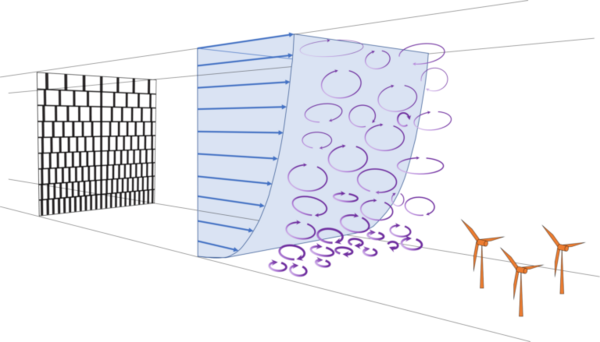
Schematic visualization of the use of a Multiscale Inhomogeneous Grid (Zheng et al. 2018) to generate a turbulent flow representative of the Atmospheric Boundary Layer (ABL) in a wind tunnel. Most of the emphasis is on bespoke designs of mean velocity, turbulence and integral scale profiles for various applications requiring wind tunnel simulations of environmental and atmospheric flows.
Numerical simulation and modelling of extreme events in the urban boundary layer for application to UAV flights
The use of drones in urban environments seems increasingly feasible due to recent technological improvements in the field of UAVs (Unmanned Aerial Vehicles). These drones could contribute in particular to the field of 3D mapping and parcel delivery. However, due to their low inertia, the use of drones in urban environments represents a real challenge. Indeed, the atmospheric boundary layer has a very high turbulence intensity due to friction with the surface and various thermal and hydric forcings. Closest to the ground (where buildings, trees, etc. are located), the sub-layer of the atmospheric boundary layer is known as the ‘roughness sub-layer’. Within this sub-layer, the so-called ‘canopy flow’ reveals very significant temporal and spatial variations that are highly sensitive to the specific configuration observed. However, it is in this sublayer that a drone is intended to operate for use in urban environments. In order to enable drone flight in an urban environment, it is necessary to characterise the external flight conditions (wind , turbulence). An LES simulation would make it possible to characterise the atmospheric boundary layer and thus identify areas that could be critical for
drone flight. The aim is to identify and characterise extreme turbulent events that may be encountered in urban environments and to develop a model of these dangerous events using reduced-order methods to enable prediction and identify the flow characteristics for which the impact on drones is poorly understood and/or critical. This data can be used to plan the location of Vertiports in urban areas and to identify drone flight paths.
Realistic modelling of urban flows
The objective is to improve the prediction of wind patterns and pollution maps to improve sustainability and health conditions in cities, with a particular attention to air quality. The main challenges of this work are ( i) to reconstruct realiable
boundary/initial conditions for CFD runs to capture realistic flow features, (ii) to combine CFD and reduced order modelling within a multifidelity mathematical framework to obtain accurate and fast predictions for decision making and (iii) to optimise trajectories of moving sensors (drones, autonomous vehicles, etc) to exploit sampled information.
Numerical modelling of turbulence in a stable boundary layer with a low-level jet under thermal and orographic forcing
Low-level jets are atmospheric structures that occur mainly at night in a stable atmospheric boundary layer. The jet is best described as a pronounced wind speed below one kilometre above the surface, a sudden change from the expected classical logarithmic profile of the boundary layer, developing at sunset in cloudless conditions. Nowadays, several realistic approaches have been made to simulate low-altitude jets over specific areas, supported by improved on-site measurement methods. This spark of interest comes from offshore wind farms. Low-altitude jets have developed above the land-sea interface, offering a potential resource for wind energy. The thesis will study the physics of low-altitude jets through direct numerical simulations on ideal cases while also introducing topography effects to see the impact of internal waves on the structure of low-altitude jets. The use of an LES framework within the ERF is expected to achieve realistic atmospheric conditions. A total turbulent energy model would also be studied. If DNS and LES provide satisfactory agreement, the work will focus on more complex simulations with a state-of-the-art atmospheric code (WRF) using comparisons with meteorological databases to verify the accuracy of the numerical model.
Coherent structures in atmospheric turbulence
Study of mixing processes and energy transfers (collaboration LMFL- University of Warsaw Institute of Geophysics)
Weather forecast is very difficult due to its dependence on parametrization schemes of phenomena such as turbulence. Turbulent scales cover a range of nearly ten orders of magnitude making turbulence modeling unavoidable. Although numerical models are getting increasingly sophisticated, the key theoretical ideas refer to early Kolmogorov theory which is constrained by assumptions of statistical homogeneity and stationarity. However, such an idealized state is rarely reached in the atmosphere. Our studies over the past 15 years have shown that well-defined balances different from Kolmogorov's appear when these restrictive assumptions do not hold, in particular in the intermediate range of scales in the atmosphere. Such turbulence states can be associated with coherent structures characteristic of atmospheric convection. Their understanding remains an important step towards a new generation of weather and climate models. A major aim of this project is to understand the role of coherent structures in non-Kolmogorovian energy transfers with a strong emphasis on the identification of the physical mechanisms responsible for the non-equilibrium properties of the turbulent energy cascade. The context and possible application is the study of entrainment rate in dry thermals and engulfing processes at the cloud boundary.
Modelling of atmospheric reentry
Collaboration with CNES and RTech (industrial partner)
The objective is to obtain accurate predictive tools which can be combined together to obtain descriptions of debris over a complete trajectory. During such path, the flow goes through very large variations of Mach (30 down to 0.1) and Reynolds numbers, for which completely different constitutive laws and models must be used. The physical behavior at the wall must also consider heat exchange and chemical reactions, therefore complexifying a lot the models at play. Considering the increasing space pollution and number of episodes of unsafe reentry, the creation of such hybrid models is more urgent than ever. Strategies coupling CFD, experiments, reduced order modeling, Data Assimilation and Machine Learning are used to pursue this goal.