




Large wind tunnels
The LMFL has numerous low-speed velocity wind tunnels (from 10 m/s to 70 m/s), including the five major wind tunnels described below.
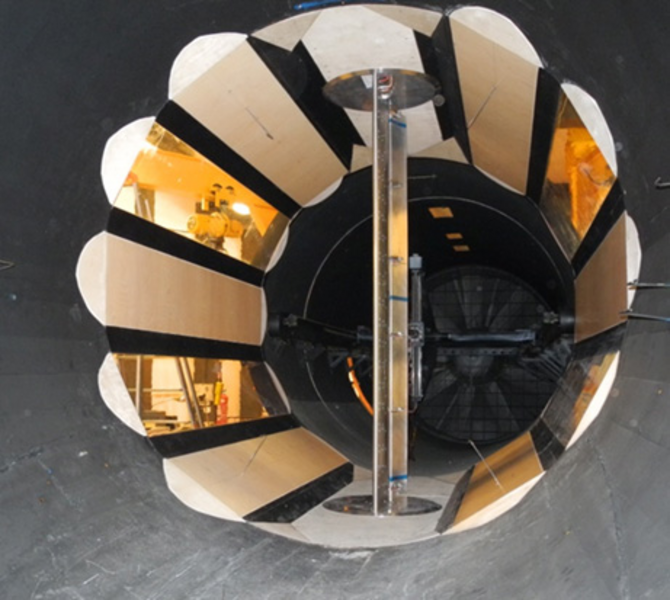
The L1 wind tunnel is an Eiffel-type wind tunnel with a streamlined return hall. Its airflow section is circular with a diameter of 2.4 m. Its maximum speed is 70 m/s. It has undergone regular upgrades and is now a flagship testing facility for ONERA's DAAA department. It offers significant versatility and a high level of equipment. It can be configured as a closed circular or closed dodecagonal duct with optical access, as a duct with guard plates to accommodate a 2D profile, or as an open duct. Various devices are available to hold and orient models or probes (under-mast mounting, dynamic PQR mounting, Monnin balance, robotic gantry, etc.).
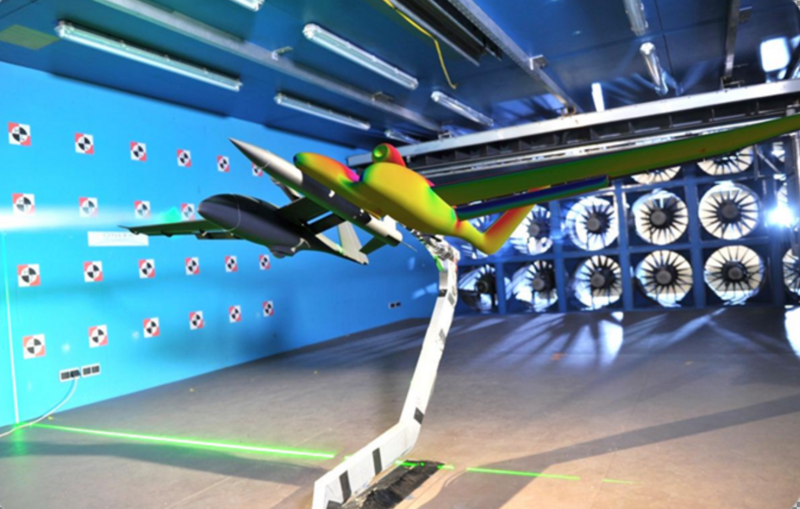
The L2 wind tunnel is a return hall wind tunnel with a rectangular cross-section (6 m x 2.4 m). It has been regularly upgraded and is now a low-cost testing facility that is particularly well suited to industrial applications but is also increasingly used in aeronautics. It offers a high level of equipment due to the pooling of resources with the L1 wind tunnel.
The SV4 vertical wind tunnel is a low-speed, Eiffel-type wind tunnel with an open duct four metres in diameter and equipped with a return circuit. Renovations have been carried out over time. Originally dedicated to testing free spins in aircraft models, it has become an essential tool for predicting aircraft spins prior to flight testing, predicting aircraft behaviour at very high angles of attack, studying major submarine manoeuvres, and ensuring the stability of devices such as parachutes and probes. The two main test devices are the rotary balance, which is a dynamic simulation device that subjects the vehicle under study to continuous rotation, and the SACSO cable robot, which is capable of moving a lightweight model in the wind tunnel with high dynamics, controlling its attitude or forces.
This wind tunnel was specially designed for studying turbulent boundary layers using optical diagnostics. It is unique in terms of its dimensions (20 metres long, 2 metres wide and 1 metre high). It can achieve a boundary layer up to 30 cm thick for speeds between 3 and 10 m/s with Reynolds numbers based on momentum thickness up to 20,000. The test section is unique in that it is transparent along its entire length and temperature-controlled. It can operate in open or closed circuit.
The test section allows turbulence grids with variable parameters (full scale, turbulent intensity) to be integrated, thus offering the possibility of generating a wide range of incident turbulent flows. In addition, it can accommodate different models (thick bodies, streamlined profiles or realistic models) to produce a variety of wakes and study their development over a long distance. This versatility allows for detailed study of the behaviour of turbulent wakes in order to meet industrial, societal and environmental challenges.
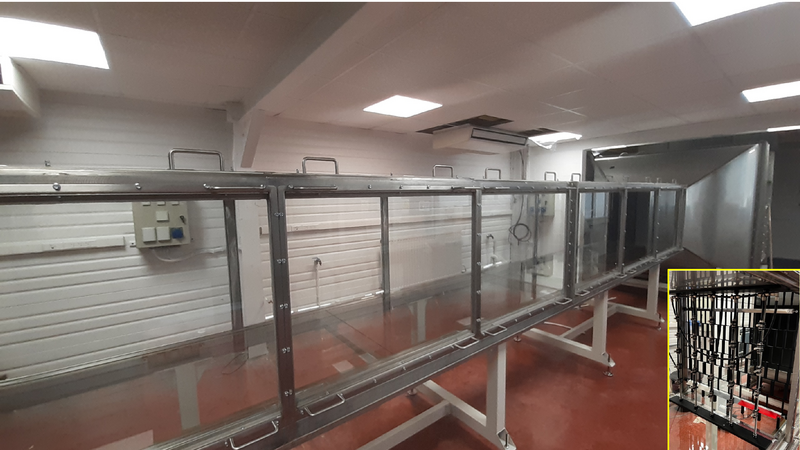
LMFL has recently constructed a fully functional two-phase wind tunnel. With a test section of 6 m long and a cross-section of 0.80 × 0.70 m², along with inlet velocities of up to 17 m/s, it allows for the study of airfoils (with both 2D and 3D geometries), turbulence generating grids, Ahmed bodies and other systems. Moreover, the flow is controlled by an array of motors that, in combination with homogeneous and inhomogeneous turbulence grids, can also be used to generate different inflow conditions. It includes uniform shear or even pulsed freestream velocity. Micrometric water droplets can be injected either from the ceiling or the test section inlet.