




Rotating flows
Presentation
Theme leader: Pierric Joseph
Keywords: Aviation; Compressor; Propellers; Inductor; Interactions; Heart pump; Space turbopump; Stability
This theme brings together research work carried out on a wide range of rotating machines, from cardiac assist pumps to aeronautical compressors. Despite the diversity of the machines and fluids studied, the common thread is an interest in ‘unusual’ situations, i.e. operation in degraded conditions, far from the design point, or with various forms of distortion or interaction.
Challenges and positionning
The flows occurring in rotating machines are, by nature, highly complex. They involve multiple moving parts and, in many cases, confinement, making them difficult to study both numerically and experimentally. However, their crucial role in many industrial sectors (aeronautics and space, but also energy and healthcare) makes them a subject of major research interest.
A distinctive feature of the LMFL is that its research focuses not so much on the optimisation and design of machines as on the in-depth analysis of flows in situations that could be described as ‘degraded operation’. From an applied perspective, machines are often used far from their design point or in environments disturbed by external elements or even by other adjacent machines. The behaviour of the flow can then become difficult to predict, with impacts on the performance, stability and, ultimately, the safety of the technical system to which the machine in question belongs.
The LMFL therefore strives to shed light on these borderline operating conditionKeywords: Aviation; Compressor; Propellers; Inductor; Interactions; Heart pump; Space turbopump; Stability
This theme brings together research work carried out on a wide range of rotating machines, from cardiac assist pumps to aeronautical compressors. Despite the diversity of the machines and fluids studied, the common thread is an interest in ‘unusual’ situations, i.e. operation in degraded conditions, far from the design point, or with various forms of distortion or interaction.
s through an approach that combines historical experimental expertise, numerical simulation and innovative methods based on the assimilation of data from different sources.
Given the issues under study, the laboratory's main partners in this area are Safran Aircraft Engines (SAE), CNES, ArianeGroup and, more recently, Lille Regional Hospital.
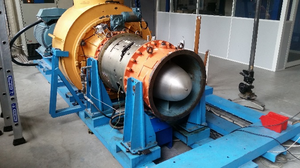
The instability of low-flow/high-compression ratio axial compressor stages is a problem that has existed for as long as they have been used in aircraft engines. The LMFL's research work is based on the CME2 (Single stage compressor version 2) geometry, which exists in both physical and digital form.
More specifically, beyond the study of unstable flows themselves, the precursors to stall and its active control (here by pulsed or vectorised jets) are also being studied. The influence of azimuthal distortions in total pressure (representative of an angled air inlet) on the stall entry mode is also an active area of research, both through experiments and the development of models for industrial applications. In line with the activities carried out on two-phase flows in the laboratory's other areas of research, the influence of a liquid fraction (in the case of rain ingestion) on machine stability will also be investigated.
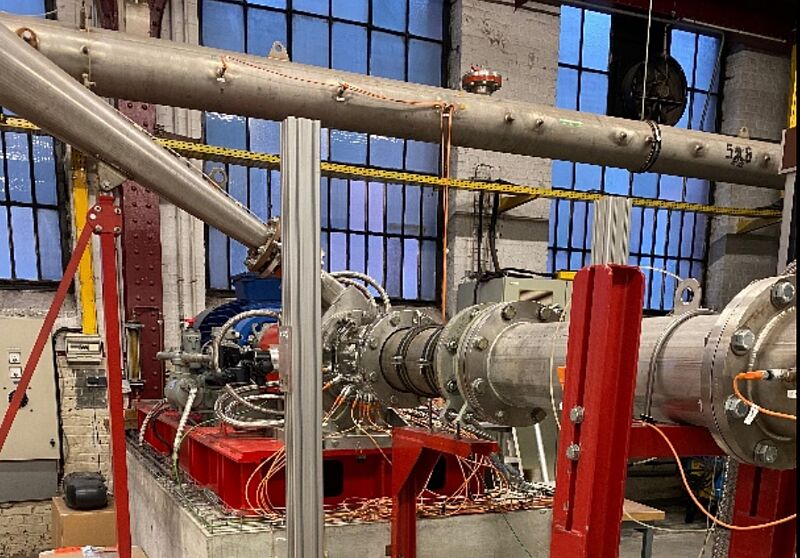
The study of cavitation in the first stages of space turbopumps (called inductors) is a key area of research for the laboratory, which has been operating a facility unique in Europe for several years. The highly specialised SESAM (‘Section d'Essais des Arts et Métiers’) loop makes it possible to experimentally reproduce cavitation conditions that are very dangerous for rockets, as they can lead to the ‘Pogo effect’, an unstable oscillatory phenomenon that can destroy or damage launchers or their payloads.
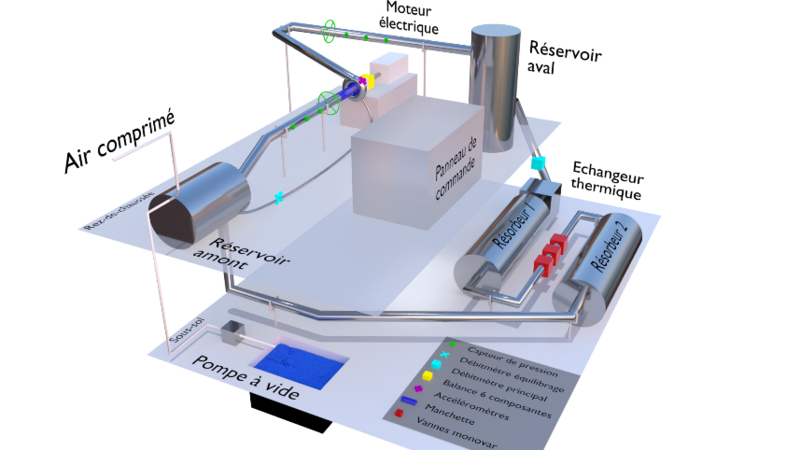
Analyses are made possible by highly sophisticated instrumentation: wall pressure, rotating balance measuring forces in the rotating reference frame, or more recently, transparent test sections of optical quality for image capture by high-speed cameras.
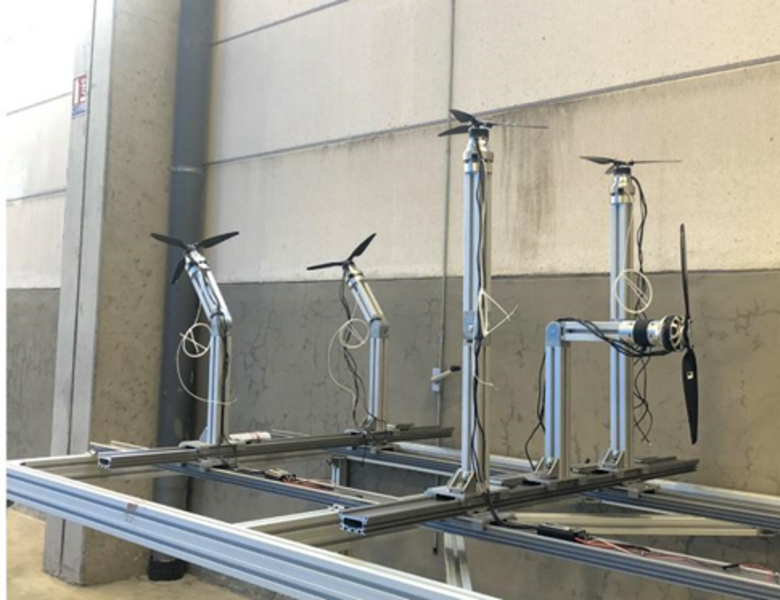
Driven by the widespread civilian and military use of drones, this area of research aims to understand, and potentially optimise, the complex interactions between the different propellers on a drone (quadcopter or more) or those found on new fast helicopter configurations (Airbus Helicopters X3 and RACER).
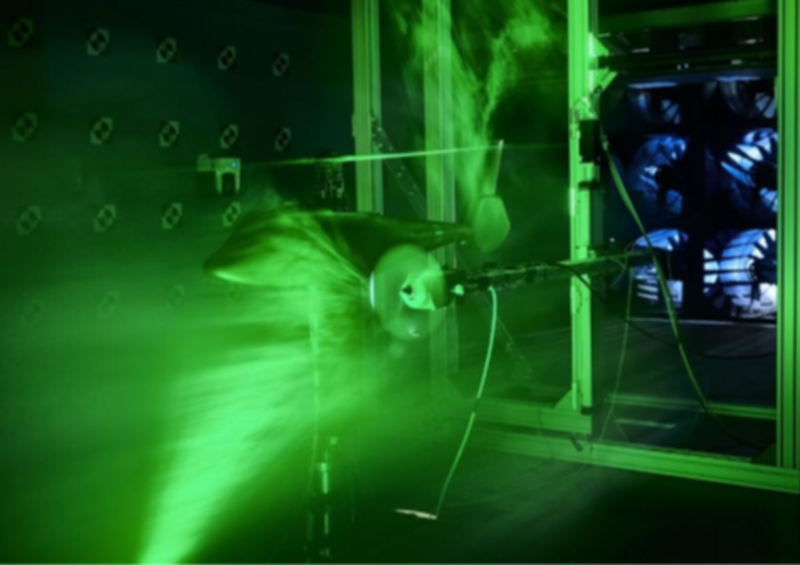
Beyond the interaction between different parts of aircraft, the complexity caused by potential meteorological or aerological disturbances is also central to this research, which closely concerns the safety and certification of this type of aircraft for use in urban environments. Another active area of research, related to the theme of flight dynamics, is the effect of total or partial power loss on one or more propulsion units in order to optimise control laws in the event of failure. The laboratory's mainly experimental work is carried out in conjunction with numerical studies produced elsewhere in ONERA's DAAA department (H2T unit), thus offering two complementary perspectives for understanding these complex aerodynamic phenomena
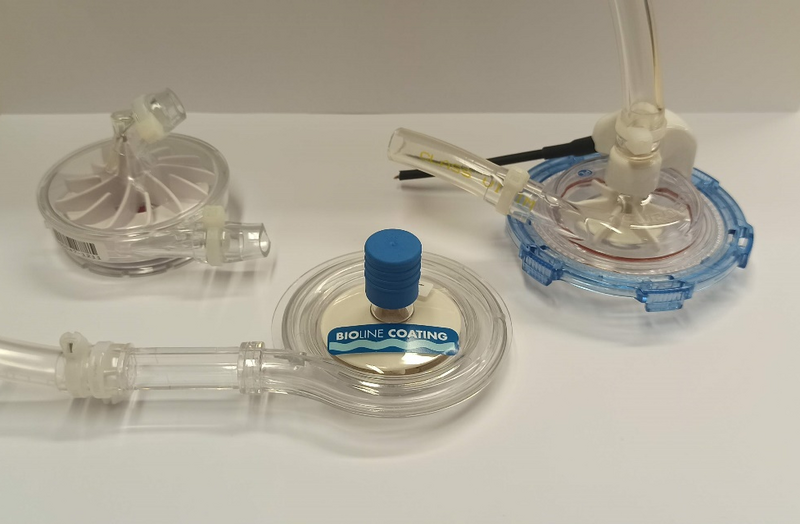
Health is an emerging but challenging research domain for the laboratory, driven by close collaboration with Lille University Hospital. It specifically concerns the implementation of external heart pumps that enable extracorporeal blood circulation during, for example, heart surgery. Blood – and biological fluids in general – are particularly complex, with potentially non-Newtonian behaviour and specific handling requirements. In the case of blood pumping, the aim is to limit haemolysis and thrombosis phenomena caused, respectively, by excessive shearing and internal recirculation in the pumps. The current collaboration with the CHR mainly involves limiting the occurrence of these phenomena, which requires understanding how existing pumps work and proposing solutions for improvement.
An important objective of the LMFL's work is to propose reliable, low-computational-cost methods for predicting complex flows in rotating machinery. This includes data assimilation methods, immarsed boundaries, Kalman filters, stability studies and various reduced-order modelling methods. These developments are carried out in the laboratory (among other places) on the RESEDA pump test bench, which is a modular diffuser centrifugal machine with large optical access points for performing PIV-type measurements, thereby enabling the various modelling methods to be compared with experimental data.